Sunday, May 26, 2013
"The culture doesn't adapt to us; we adapt to it."
As we were preparing to leave for our "light" hike today, we were told we would be taking the same kind of transportation as a typical Guatemalan. What we didn't realize was that - like the children we saw leaving school for the day on Friday afternoon - we would be climbing into the back of a pick-up truck, squishing together, and holding onto a bar that runs down the middle of the truck bed. Our fellow riders were clearly entertained by our awkwardness and could clearly tell this was our first time in a "picop". While we all stood crushed together, our trip leader assured us that there was plenty of room for more people and that it is important for us to understand the daily experiences of Guatemalan culture - it is our job to appreciate the norms of San Lucas. It is not the job of the community to change for us. This ride was definitely not our first experience of setting aside our own natural inclinations to become part of the community, but it's one of those experiences that would play well if there were a comedy written about our experiences navigating this new place.
Since today is Sunday and a day of rest in Guatemala, we did not work today. I don't know that anyone in our group would say today was restful, but it was enjoyable and insightful.
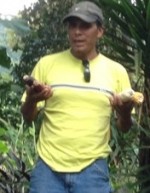
We spent most of the day with two guides hiking through the mountainside. We learned about the intersections between Mayan culture and modern farming practices. We tasted, smelled, and touched more plants and fruits than I can possibly remember. We ate freshly picked passionfruit, which is definitely not at all like the passionfruit-flavored drinks that dominated the processed food landscape in the US a few years ago. There's nothing really like fresh produce though - so there's a part of me that knows it's ridiculous to even compare such things. While we spent hours learning about permaculture and other agricultural matters today, maybe the simplest way to describe our lesson is that there must be balance between the needs of people, the environment and the economy. The world is meant to be in equilibrium and practices like single-crop cultivation create vulnerability for people, land, and economies.
In our short few days here, we've already learned so much. There's no way that any post I'll write will encapsulate this experience, but hopefully, you'll be able to get at least a glimmer of what it's like here. Candace, our trip leader, is so knowledgeable about Guatemala that it seems as though there isn't a question that she can't answer or quickly find an answer to through her network of local friends and experts. Yesterday, we toured the kitchens of all of the families who will be receiving new stoves, met our supervisors, and began our work. More to come on that another time...


Sunday, December 2, 2012
Guatemala
Saturday Dec. 1
We arrived yesterday Friday Nov. 30 in
San Lucas. We are staying at a small hotel owned by the Mica family,Felipe and his wife Marbilla. It is very simple and primitive to
what we are accustomed to but very hospitable. The dinner they
served was stupbendo they are truly a gracious couple. Feilipe is the
only one of the two who speaks English. He has had throat cancer
and speaks through a tracheotomy. It is a standing joke among them
that I introduced my self as Migualito which is “Little Mickey”
because this is a very macho culture.
This afternoon we visited San Gargordio
the community where we will be building our stoves. We were welcomed
by a large contingent of women. Most of the men are off harvesting
coffee to make a little income. The project, however, is spearheaded
by the women and the very concept is empowering to these women. Its
fascinating the way things are working. After an introduction we
visited each of the houses that are to receive the first of the
ovens. The living quarters are quite modest – concrete block
structure, while the kitchens are detached and formed out of
corrugated metal. The insides are black, coated with creasode from
the smoke. An article in this months Smithsonian explains that most
of the undeveloped world cooks over these open fires and that an hour
under these conditions is the equivalent of smoking 40 cigarettes.
This as you can see is a significant problem for these beautiful
people and their children.
Afterward we were given a detailed
description on how these stoves work. They were designed by a NASA
Engineer and are truly a remarkable improvement in the existing
technology these people have been using for centuries. They are far
more fuel efficient preventing the destruction of forest and provide
a smoke free environment. It's a wonder to behold and to which be a
part.
The third aspect of this endeavor the
empowerment of these women, the fabrication (of which we are a small
part) is the education. These women undergo an extensive program so
that they can utilize and take advantage of these stoves. Its an
ongoing program and as long as they utilize the stoves properly and
do not modify the design (e.g. Enlarging the opening to burn larger
pieces of wood.) The stoves burn only twigs and small branches.
They will be entitled to future help and repairs as necessary to the
stoves.
We road back to San Lucas in the open
air pickup truck. Each of us truly moved and encouraged by what we
had learned not only from Candace, our director, but from these newly
empowered women.
Tuesday, June 19, 2012
Guatemala Transformational Journey Blog June 19 - Back Home!
We have made is back from our Journey, and what a Journey it was! All the projects were completed as 7 stoves were built for women and their families. The roofing project was completed Friday and the family was extremely grateful for having that completed. Reflecting back, it was an amazing trip! It had it's share of challenges: many of us got ill for a day or two, the roofing project had to be modified a little, some rain issues slowed some projects down...and yes, some language barriers that made communication interesting! In Summary, it was a blessing for us all, and refreshing to know that God works in many ways that we do not see or understand at the moment. The people of Guatemala were awesome...people of strong faith and work ethic, and one thing that many of us learned from them is that we should keep a strong faith in God, while giving what we can to help others.
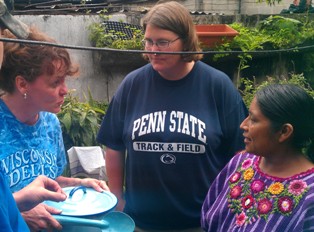
Kathi Vandel giving a Gift to a grateful Lady who had a stove built in her home.
Jeremy Abshire Talks about the Roofing Project Completion (Below - You Tube Video).
http://youtu.be/qRQQJB5uTCY
Thursday, June 14, 2012
Guatemala Transformational Journeys Blog June 14
Hola from San Lucas Guatemala!

It’s hard to believe that things are coming to a close here in San Lucas!
The roofing project is almost complete, and could have been finished today..but the rain had different ideas. At noon the rains came and shut the construction down, but according to Rogers Strickland, should be completed tomorrow on schedule (sounds like a construction guy!)
The stove project is nearing completion also, and should be wrapping up tomorrow as well. As far as the schedule for this group. Friday – wrapping up work projects, Saturday – a day in Antiqua, Sunday – Trip Back. This is part of the journey to where we are sad to go, but are looking forward to getting home to our families and friends.

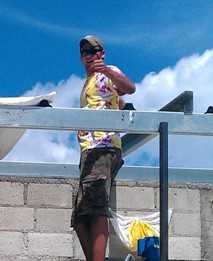
Aaron Sommer gives a “thumbs up” on roof construction progress.
May God Bless!
Adios Amigos until next time!
It’s hard to believe that things are coming to a close here in San Lucas!
The roofing project is almost complete, and could have been finished today..but the rain had different ideas. At noon the rains came and shut the construction down, but according to Rogers Strickland, should be completed tomorrow on schedule (sounds like a construction guy!)
The stove project is nearing completion also, and should be wrapping up tomorrow as well. As far as the schedule for this group. Friday – wrapping up work projects, Saturday – a day in Antiqua, Sunday – Trip Back. This is part of the journey to where we are sad to go, but are looking forward to getting home to our families and friends.
Aaron Sommer gives a “thumbs up” on roof construction progress.
May God Bless!
Adios Amigos until next time!
Wednesday, June 13, 2012
Guatemala Transformational Journeys Blog June 13
Buenos Diaz!
Yesterday (June 12) the group worked on finishing the first round of stoves and started the second round of stove building. The people were quite excited to have this installed in their homes (replacing for most situations an open flame on the floor), and were the talk of the neighborhoods. The children were happy to interact with us, and learned some new words from us (Jay Nower = Mucho Gringo) and other activities (Mattie Vandel teaching the young girls cartwheels like a cheerleader). Below are the stoves and the progress….exciting progress!


The roofing project is in full swing, and made some amazing progress yesterday. Some of the leaders say we are 60-70% completed. Below are some pictures..
 Rogers Strickland was on the roof and with the aid of Jereme Abshire & Crew, made great progress.

Jereme Abshire running the impact wrench

Daniel Strickland running the Roof Seamer.
Yesterday (June 12) the group worked on finishing the first round of stoves and started the second round of stove building. The people were quite excited to have this installed in their homes (replacing for most situations an open flame on the floor), and were the talk of the neighborhoods. The children were happy to interact with us, and learned some new words from us (Jay Nower = Mucho Gringo) and other activities (Mattie Vandel teaching the young girls cartwheels like a cheerleader). Below are the stoves and the progress….exciting progress!
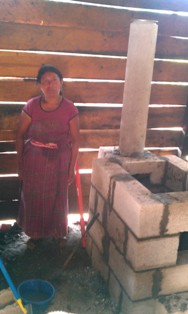

The roofing project is in full swing, and made some amazing progress yesterday. Some of the leaders say we are 60-70% completed. Below are some pictures..
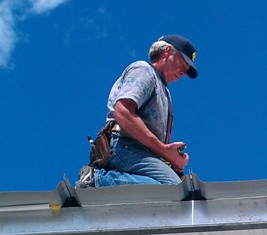 Rogers Strickland was on the roof and with the aid of Jereme Abshire & Crew, made great progress.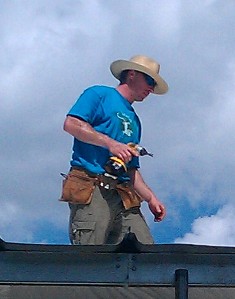
Jereme Abshire running the impact wrench
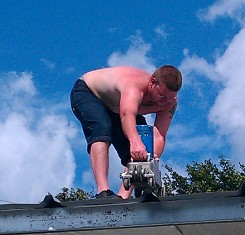
Daniel Strickland running the Roof Seamer.
Monday, June 11, 2012
Transformational Journeys Guatemala Blog June 11
Wow! What a blessed day we had working down at San Lucas! Some of
us worked on the roofing project (more on that on the next blog!).
About half of the group worked on installing stoves that were installed
in homes in San Lucas. Now....these weren't the kind you buy at Wal
Mart, Sam's Club, or Nebraska Furniture Mart. These are made from
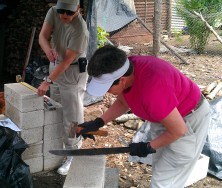
Concrete Blocks! Today we spent the day with 3 local masons who helped
with these Stoves. To construct these stoves, we had to cut concrete
blocks with a machette (Large Knife normally used to cut vegetation).
We also had to mix the concrete and help with the construction of these
stoves.


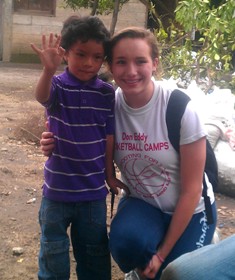
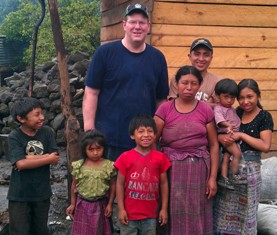
It was a great a rewarding time to help these families to get something that is more effecient, safe, and healthy for the family. This will keep the women from cooking over an open flame...and help them prepare meals more effeciently! Tomorrow we will be working on the roof. Adios until next time!
It was a great a rewarding time to help these families to get something that is more effecient, safe, and healthy for the family. This will keep the women from cooking over an open flame...and help them prepare meals more effeciently! Tomorrow we will be working on the roof. Adios until next time!
Sunday, June 10, 2012
Guatemala Transfromational Journeys Blog June 10
June 10, took a tour around lake. Got the history of San Lucas, which
is almost 500 years old (est 1515). San Lucas also was moved from
another location to the lake as a result of Animal activity (Lions &
Tigers), and they moved to the lake near San Antonio (NOT the one in
Texas, this one is in Guatemala!) This community of San Lucas grew
because people immigrated to town. 27,000 people live here now, that
started with 11 families. Around lake there are 3 mayan dialects that
are spoken around different towns on the Lake. 80% of the land grows
coffee (cash crop). The other 20% grow corn, beans for local
consumption.


 Tomorrow the Work Projects Begin....Stay Tuned!

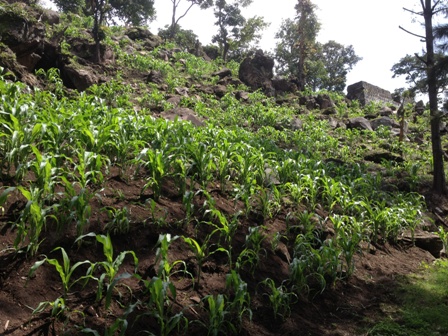
With the Mayan Culture, we learned about the importance of corn,
and how it it planted. The corn is planted 2 feet apart with 4 seeds
per hil..and is planted in rocky places and hand cultivated there.
After a 5 kilometer hike, learned about permaculture and the local seed
bank. The corn colors coincided with the color associated with
direction. (white corn marks north), it also matches the moon phases.
The theme of the Discussion is to use the energy to your advantage
which includes: gathering seeds, planting, and other activities that
rely on energies for best results. The Mayans have practiced the art of
using the moon signs for activities for thousands of years.

 Tomorrow the Work Projects Begin....Stay Tuned!
Subscribe to:
Posts (Atom)